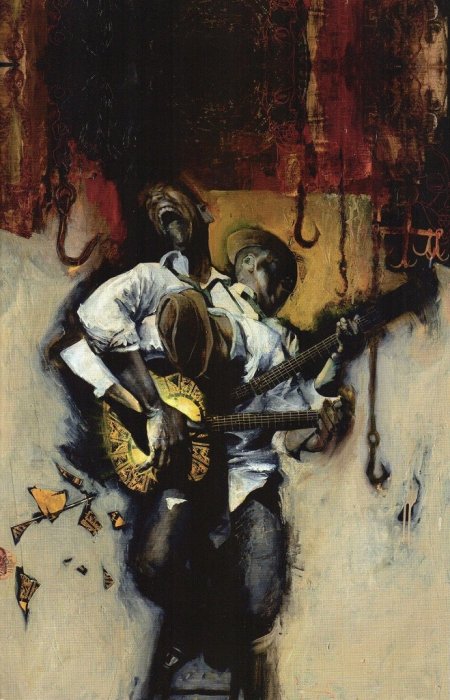
Creating a pitch

It’s been too long since my last blog post so I thought I’d whip up a couple things real quick until I get back on track.

Since I’ve been sharing my scripts I thought I’d share another aspect of the creative process: creating pitch packages.

I’m working on my third major pitch, for Visions from Punktown, and I’ve done two others: Pale Riders and Empty Zone. While only Empty Zone was picked up (by Image Comics), I received positive feedback from editors for the professional look of both. Pale Riders is the more comprehensive pitch of the two, mainly because I had a more invested collaborator.

I am sharing the EZ pitch for a few different reasons:

Since the arc that I had spent almost a year writing, “Conversations with the Dead,” has now been published as Empty Zone issues 1-5, there won’t be any spoilers for those who have read it. Pale Riders I still plan to release after a major rewrite and would prefer to keep some of it under wraps. But I will share portions that don’t contain spoilers.

I worked extremely hard on Empty Zone. Damned hard. I’m proud of the effort and energy I put into it. Science fiction is not my preferred forte, but I love a challenge and threw myself into EZ. In many ways, I have that experience to thank for giving me a new appreciation for the genre. This has led me to adapting the Punktown stories of Jeffrey Thomas for the upcoming Visions from Punktown comic book anthology.

I want to finally share my version of “Conversations with the Dead” and give fans a glimpse of what could have been. I’ve had people who’ve read the trade paperback tell me they had no idea I worked on Empty Zone, and ask what the story contributions credit is all about. It’s complicated.

Basically, in non-litigious terms, I was asked by the creator, a former friend, to help him reboot his book, last published, but unfinished, in 2002 by Sirius. Things went down and I was forced to leave the book. The creator had no rights to my scripts since they weren’t paid for or done as work for hire. But he did anyway, swiping dialogue, scenes, characters and ideas and then slightly rewriting them. Not cool.

I was forced to get a lawyer, and after a lot of back and forth we settled out of court. The story contribution was part of that settlement. Lesson learned.

With that out of the way, back to creating a pitch.

Now, my  approach is by no means set in stone. I took information from various internet resources and put together a package that appealed to me. I would encourage creators to get creative and have fun with their pitch, but make sure to hit certain key points.

Also, in re-reading this material, I found some embarrassing grammatical errors. Get someone who has a good eye for grammar to read over your pitch. A fresh pair of eyes is always good for catching mistakes you might not have seen. Especially if you are cross-eyed from writing for days on end. After you finish writing something it’s always a good idea to put it aside for a few days, then re-examine it after the writing adrenaline has worn off. The closer you are to a project the more likely you are to overlook small things like a missing word or poor syntax. Your brain may have a clear picture of what it wants to write but sometimes the eye doesn’t catch when the fingers miss a beat putting it on paper/screen.

Now on to the contents of a pitch package:

COVER PAGE

This could be something simple, like the front page text of your average script, but I would suggest making it more appealing. EZ had a simple text cover page, but for Pale Riders we added a stylized logo designed by the amazing Rafa Garres, and Dug did a cool little illustration. It goes a little further in showing how serious and excited the team is about the project and how much effort they are putting into it.

pr-pitch-cover-page

COVER LETTER

A cover letter should be short and sweet and make an impression. While some editors go straight to the art portion of your pitch, others will read your cover letter to gauge your ability to sell a story.

Editors all have different things that pique their interest and there’s really no way of knowing what that is in advance. I would suggest searching online for interviews or articles about or by whoever you are planning to send the pitch. Oftentimes, you will glean little nuggets of important insights you can include in your pitch. You can mention things the editor worked on that you liked, and so forth.

The basic rules of thumb are to be succinct and give the editor an idea of what they will be seeing and why they should be interested in it.

Here’s one of the many cover letters I wrote for Pale Riders:

pr-pitch-cover-letter

 BIOS (optional)

This may be a good idea, especially if you are lacking in enough comic book credentials, like Dug and I were. I included reviews of my work to show that my writing was well received by critics. Since I only had published short stories, convincing a publisher to invest in something longer from an untested writer was a long shot, and I was doing anything I could to inspire confidence.

LOGLINE/TAGLINE

Loglines and taglines are popular movie and television terms. I actually used logline incorrectly in my pitch, as mine reads more like a tagline. While both should be brief (1-3 sentences), the logline should speak to the dramatic narrative, and the tagline is more about exciting marketing, akin to something you would see on a movie poster.

I wouldn’t say that either of those are necessary for your pitch. But it doesn’t hurt, and it helps hone skills in an area that may come in handy. I would suggest only using one or the other, not both. If you use one, it should precede your synopsis on the page.

SYNOPSIS

This is probably the most important element of your pitch. This is your sales pitch. You should able to summarize your story in under a page, but make it exciting. The objective is to make the reader intrigued enough to want more. Give it some flavor of the writing the reader can expect on the pages.

You can search the internet for all kinds of examples of synopses. Here’s the one for Pale Riders. I jazzed it up a bit with graphics, totally optional.

pale-riders-pitch-synopsis

BREAKDOWNS

This is where you show your plotting skills. The breakdowns are scene by scene synopses that comprise each issue. Do your best to keep it under a page per issue/chapter. Pages and pages of unending text can really turn an editor off, and she likely has a stack of other pitches and work to get through. Showing that you’ve got a nice, streamlined and organized pitch can show an editor that you’ve done your research and understand the inner workings of such things. Ignorance is no excuse when the internet is teeming with examples and advice on creating a pitch.

I don’t want to give away the story of Pale Riders, so you can see my issue by issue breakdowns for Empty Zone by clicking the link at the end of this article.

PAGES

Depending on who you ask, this is the second most important part of your pitch. This is, of course, a visual medium first and foremost. Some editors will skip straight to the art to see if it’s even worth their time, so don’t skimp.

Most people suggest 3-5 pages of art, in various stages of completion, but most certainly inked. I recommend getting them professionally lettered. It just elevates the whole look of the pitch, and highlights your dedication to the project. Reading a script is one thing, but seeing the words interacting with the art reveals how well the two elements blend. Color may not be necessary, but if you have a colorist, I would color at least one page. A colorist contributes so much to the mood and atmosphere, and therefore will also enhance your pitch. I wouldn’t color all the pages, though. There’s always a chance an editor might not like the colors and suggest a different colorist. You don’t want to obscure your pencils in that case so he can see what he is working with.

For Pale Riders, we included all 24 pages, which comprised the first issue. The first 10 pages were colored and lettered, and the remaining were inks only. But that was a long time ago, and I would do things differently now.

I was overconfident about Pale Riders getting picked up by a publisher. Unless you’re prepared to self-publish in the event you don’t get a publisher, doing too much of the art in advance can hamper your format choices and inhibit editorial input. Rewriting is easy compared to an artist scrapping pages to accommodate a rewrite. Since I wrote the PR scripts years ago, I feel my writing has dramatically improved. My conscience won’t allow me to finish the series knowing that I can improve upon the scripts. This will require the artist to redraw quite a few pages. And since he has also improved, he has to match the old work so that the pages don’t appear too disparate.

So, you see some of the problems you can encounter if you get too far ahead of yourself. Take your time, get others to read your work and provide input before you move on to having inked pages.

SCRIPT

You should include the finished script for your first issue/chapter. If you’ve written all the scripts, let the recipient know that they are available.

CAST OF CHARACTERS

Giving the editor a glimpse at what other characters will appear can give a better impression of the depth and breadth of the story. Have fun with the descriptions to avoid making them sound one-dimensional. Here’s the CoC from Pale Riders:
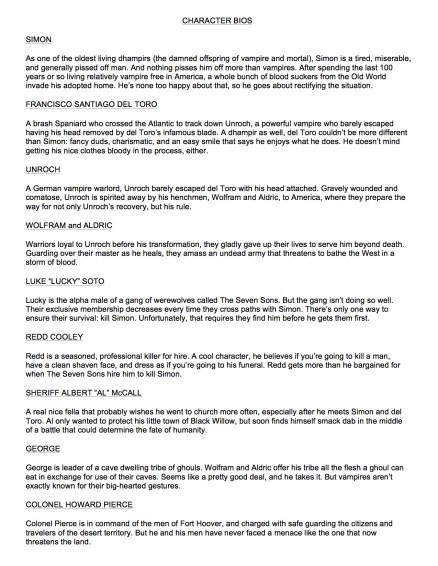
pr-pitch-coc

CONCEPT ART

Self-explanatory, really. Sketches of characters, settings, devices, etc. Here’s another PR example:

There are some other optional elements you can add to your pitch. This mostly goes towards showing how well you’ve planned out your project. You can also mention that the additional elements are available upon request so that you aren’t overwhelming the recipient.

Some of those elements are:

THUMBNAILS

To show the artist has laid out the story from the scripts.

ADDITIONAL SCRIPTS

Speaks for itself. If you’re really serious about your project, there’s no excuse for not having several issues/chapters scripted in advance.

EMPTY ZONE

As promised, below are the links to the pitch and scripts that I wrote for Empty Zone. I would’ve preferred for the EZ pitch to have been more robust, but the creator did not agree.

The pitch was originally for six issues. But as I started fleshing out the scripts, I realized we could make it into five issues.

You’ll notice a lot of unfinished parts in the scripts. This is because I did not have an opportunity to rewrite as I had planned since I had left the project. There were characters that needed refining, dialogue and scenes to tweak, as well as grammar and error corrections. There were also scenes from the Sirius published EZ: CwtD that I wasn’t sure how I was going to rewrite yet, so I simply put in a quick visual description of the 2002 artwork since the artist wanted to include some of the old artwork to reduce his workload.

Something all of us experience as writers is getting stuck on a scene. Some can’t get past that until they figure out a solution. That can really slow a project down. I started getting in the habit of just writing barebones elements as placeholders to come back to, and forge ahead to the next scene. One writing adage that comes to mind is “Don’t worry about getting it right; worry about getting it written.”

If you compare my scripts with what was eventually published, you can easily see why the creator eventually had to relent and give me a “story contribution” credit.  Given the significance and amount of my involuntary “story contributions,” one could reasonably argue that the term is inadequate.

And, finally, lest there be any misunderstanding about my reasons for making this material available, I am doing so primarily for educational and informative purposes, for people to glean from what they will, be it the creative process, or the pitfalls of uneven collaborative efforts between partners.

The scripts are legally copyrighted in my name, though I lay no claim to the creator’s pre-existing characters and plot, only to the original ideas, scenes, and characters that I added to his work, as intended by the creator when he asked me to help him relaunch the property. This was not work for hire, therefore I am under no contractual obligations to refrain from sharing my work.

Please don’t hesitate to contact me if you have any questions about the creative or legal elements of this article.

Thanks for your continued support!

–Chris

UPDATE: Someone pointed out that the EZ sequential pages in the pitch didn’t match the script attached to it. That’s because the artist decided at the last minute that he would not do the scripted pages for the pitch as we had previously agreed. I certainly don’t advise that, but my hands were tied.

Also, I was also informed that the cover pages for all four scripts read as “Issue One,” although the contents were correct. I went ahead and fixed the issue by removing the cover pages altogether, and just adding the issue number to the header for ease of reference.

I decided to switch out the links for one that combines all the scripts (as well as a few pages of issue five’s script) so that you don’t have to click on each individual link to read the scripts.

I apologize for the confusion.

Cheers!

empty-zone-pitch-package

empty-zone-issue-1-5-scripts

Writing Exercise: Locust Stars

Sometimes I do writing exercises to stretch my brain, or take a break from whatever project I’ve chained myself to. One of my favorite writing exercises is taking a piece of art and writing a quick backstory to it. Sometimes I’ll flip through an art book and land on one at random, and sometimes one will just pop into my head.
Eric York has created enough work to fill universes. My brain has been itching to play with his worlds and characters, and he and I have discussed that possibility. For the time being, I took one of his recent pieces featuring a recurring character of his, Uncle Tillinghast.
The goal is to only spend a few minutes and write something off the top of your head; let one idea flow into the next and culminate in a natural ending. Sometimes, you’ll find that little exercises like this can become full borne ideas for future projects.
It’s also a fun way to interact with friends and artists. Someday I’d like to evolve it into a collaborative exercise within creative communities, with writers and artists trading word and images for the other to interpret, like a variation on the Exquisite Corpse game.
Here’s Eric’s piece, “Locust Plague,” followed by my text. Eric has my favorite Deviant Art page. I urge you to go visit it: http://tillinghast23.deviantart.com/gallery/  (Contains mature content)
LOCUST PLAGUE TILLINGHAST
“Locust Plague” by Eric York.
     Uncle Tillinghast gazed into his window of the universe, and counted. He counted the stars to see which ones have died out like candles run out of wick, and which ones have been snuffed out by devouring darkness. For a great shadow lurked in the corners of the cosmos, reaching out with inky black tendrils to extinguish all light and life to feed a gnawing, aeon eternal hunger. It existed at the birth of this universe, and will exist even after its death, when it eats its own tail, like Ouroboros, leaving only one last flickering anus of light. And then it will shit out another universe with new gods, new devils, new rules. But no Tillinghast.
     He watched the locust lights flit and buzz about his moon room. The soft murmur of their wings and luminescent bodies usually a calming presence. But the thought of a universe without Tillinghast plotting and scheming his way into the apex of ascension troubled him. He quite liked this universe, and him in it.
     He stabbed the air with his cane and impaled one of the  creatures. He watched its wings and legs wriggle frantically as its phosphorescence sputtered and oozed down his cane. Like a tiny, dying star.
     Uncle Tillinghast pulled down his scarf and sucked the creature into his unseen maw. He chewed thoughtfully, and schemed.
     He wondered what stars tasted like.

The Last Illusion

After working on Hellraiser: Bestiary for Boom, I started pressing Boom and Barker’s people about putting Harry D’Amour in comics. Harry always felt like a cross between Philip Marlowe and John Constantine to me. Being a big Hellblazer fan, and having written a couple pitches for him, as well as wanting to write some pulpy noir stuff, I felt D’amour could satisfy both desires.

LORD OF ILLUSIONS

Poster for the 1995 film adaptation of “The Last Illusion.”

My idea for adapting “The Last Illusion,” D’Amour’s first appearance in print, was to make it a prologue to an ongoing series starring D’Amour. Harry is a character with so much history unexplored (though I haven’t read “The Scarlet Gospels” yet). It would be a thrill to contribute to filling some of that in.

Adapting a few scenes from “The Last Illusion” was my second attempt at adaptation work (the first was a Robert E. Howard short story), and it really gave me the bug. It’s very satisfying to bring great work to another medium. But for me the real fun of the challenge is to present it from a new angle, something that offers existing fans a different way to experience the work, and maybe guide new fans to the original work.

Too often in comics, I see writers take the cut and paste approach to adaptation. Sometimes that’s out of laziness or inexperience, and sometimes reverence for the source material. For the latter, why even bother, then? Sure, it’s great to see some visual interpretation of a beloved story, but if I want to enjoy a story I’ve already read, I’ll just read it again. Also, since you’ll never be able to fit everything into a blow by blow adaptation, the work ends up feeling incomplete to me.

Another area writers seem to falter in when adapting is self editing. Sometimes they leave in way too much of the original text or scenes. Yes, that one scene was awesome, and yes, you love that passage of prose the author wrote, but the same principles apply as when writing your own stuff: learn to cut the superfluous material. Use economical wording to control the pace. The pacing for any medium, be it short story, novel ,comic book, or film, will be unique unto itself and therefore must be adjusted for any adaptation into another format. Find ways to present that text with half the words. And don’t forget your co-storyteller, the artist! The art should be doing some of the work. Those words that so inspired you should also inspire the artist, and, in a way, replace those same words. A good artist already knows this, so find one who understands that and is up to the challenge.

Many comic book writers seem to get trapped in interior monologues. In a novel or short story, an author can afford to spend an entire page or more on a character’s interior monologue. In a comic book, it really throws off the pacing and can imbalance a story. A writer doing adaptations really needs to learn how to boil things down to their essence. You also have to keep the letterer in mind. Few things are less attractive than a page full of dense captions and balloons. Not to mention it can obscure the amazing artwork of your co-storyteller. So don’t be afraid to reword that character’s lengthy ramble so that it takes up less space. The benefit is that you learn how write for brevity without sacrificing the power of language.

Writers should not be afraid to inject their own original ideas into an adaptation, nor hesitate to alter things like scene chronology, eliminate or combine characters, reduce cumbersome flashbacks to single panels, or whole chunks of dialogue. Indeed, these changes should be encouraged. Often times, it is a new idea that can solve problematic sequences by transducing the author’s original material into a more compact, and impactful, element, while still staying true to the spirit of the work.

Using my D’Amour script as an example, on page 2 panel 4, a woman references Harry’s case on Wyckoff Street. In the original story, information is relayed to the reader about that case. You could easily relay that same information in a caption, but it would be dry and lack excitement. I don’t like easy. I like to work hard at storytelling.

Since D’Amour appeared in a few other books from Barker, I created a timeline pertaining to everything Harry D’Amour. In that timeline, events in Everville go into more detail about the Wyckoff incident. I used imagery and text from one of the “Everville” scenes and crafted it into a single flashback panel to replace information in “The Last Illusion.”

It’s dramatic, horrifying and cryptic. And fit well into my proposed plan to use the existing timeline for Harry D’Amour as a guide for filling in his life between and around those published instances, allowing for a mixture of original content, as well as reference what had already been published. I employed the same device again when Wyckoff is referenced once more, and used that opportunity to reveal more of the Wyckoff incident, ramping up the tension and hopefully instilling a sense of dread in the reader about what happened on Wyckoff.

I have a selfish reason for this, too. As much as I genuinely enjoy adapting someone else’s work, or working from another’s ideas, nothing brings me more satisfaction that writing my own original material. So if I can inject something original into an adaptation, I can feel a certain sense of ownership. Obviously, I would never supersede the author’s ownership, or seek to diminish it in any way. It’s a humbling privilege to work on another writer’s work, and I would only do it if I felt I could treat the author and his or her work with respect.

One of these days soon I’ll post some scans of what the process of working from story pages  looks like. I print up the digital versions (fairly purchased!), and then do my mark ups for the eventual script.

I’m always up for discussion and questions about the creative process, so please feel free to contact me.

Finally, here’s what you came for: The script sample for Clive Barker’s “The Last Illusion.” I’m also including the excerpted scenes from the short story that I chose to adapt for your own reference.

Maybe we can get a movement going to convince Mr. Barker to let me do this, yeah? 🙂

The Last Illusion exerpts copy

D’AMOUR SAMPLE SCRIPT

Hellraiser

My third published story took an interesting route.

I’d always wanted to write a Blues inspired story for an artist I used work with, Jason Shawn Alexander. He loved the Blues, and it rubbed off on me. The rawness and harsh realities of many Blues songs can take one’s mind to dark places…

Hellraiser bestiary #2 copy
The variant cover for Hellraiser: Bestiary #2

I had a title stuck in my head for a long time: “Old Hat to Raise the Devil”; a turn of phrase describing the means to do just what it implies. I got the title just flipping through a book for inspiration, the excellent and highly recommended Encyclopedia of Occultism by Lewis Spence. Combining that title with the Blues theme, I wrote a prose style, one page pitch about about a young man inspired by Robert Johnson sell his soul to the Devil. Jason loved it. We pitched it to Vertigo for one of their occasional anthologies, but only got mild interest. Jason showed it to Mike Richardson at Dark Horse, and he was very interested in getting it into Dark Horse Presents. But we couldn’t get any real commitment or movement from our follow ups, so we let it sit for awhile.

Hellraiser bestiary 2 regular copy
The regular cover for Hellraiser: Bestiary #2 by Sam Shearon

Inspired by a Pinhead sketch that Jason had done, I suggested we pitch the idea of doing something Hellraiser to Boom! Studios since they had been publishing the licensed title.

I don’t remember how much time passed, but enough that Jason and I had moved on and were working on Empty Zone. Then Jason got an email from Boom! letting us know they had a Hellraiser anthology in the works and would we like to pitch a story? (In a future entry I will write about Clive Barker’s significant influence on my decision to pursue writing.)

We were excited by the idea, but had no idea what to pitch. We just knew we wanted to do something different. It occurred to me that we might be able to do something with “Old Hat.”

HR_Bestiary02_letters_pg3
Page 3 interior art for Hellraiser: Bestiary #2

Then it hit me: What if it wasn’t the Devil that  the young man met at the crossroads, but Cenobites?

I wanted to do something other than the Lament Configuration box. It just made sense to me to make it a steel guitar. I threw in the idea of a thirteenth string just give it a little more sinister inference. (Jason texted me a few times about how much he hated that guitar because of the difficulty in designing it with moving parts in mind, but there’s no denying that the end result was a gorgeous centerpiece to the story.)

The other thing I wanted to do was make the story read like one you could imagine a Bluesman writing a song about.

HR_Bestiary02_letters_pg4
Page 4 interior art for Hellraiser: Bestiary #2.

I rewrote my original Old Hat pitch and sent it off. More time passed, but they finally got back to us and let us know they loved the pitch and wanted us to do the story.

I’m happy with the results, and the story got great reviews. I really wanted to do more with Hellraiser, as well as Barker’s other properties. He has always been such a huge influence and inspiration to me. I went so far as to write a 20 page spec sample script for adapting “The Last Illusion.”  In fact, maybe I’ll include that spec script in a future entry.

In the meantime, here’s the original short and long pitch, as well as the rewritten pitch for Hellraiser and subsequent script.

Original pitch: OLD HAT copy

Rewritten for Hellraiser: UNTITLED HELLRAISER PITCH REV copy

The script: HELLRAISER OLD HAT LETTERING 051214 copy

“Beta-Eden”

My second sold story came right on the heels of my first, which should have been great for getting me some momentum as a published writer. But a schedule change pushed the release to almost a year after Creepy #6.

I love working from prompts, and Dan Braun had mentioned looking for a story with a classic twist, one that then went one twist further.

I sent in several pitches with that in mind. “Beta-Eden” was the only sci fi story in the batch, and I was hoping that they wouldn’t pick it. I’ve always been intimidated by science fiction and didn’t feel it was an area I could be strong in.

Of course, they picked “Beta-Eden.”

It was scheduled to run in Creepy #7, which would give me back to back appearances. Even the solicitations for #7 listed me in the credits. But there were plans to revive Creepy’s sister publication, Eerie, and they wanted some sci fi horror for that series, so it was decided to move my story to Eerie #1.

EERIE #1 COVER

Cover to Eerie #1. Cover art by Jim Pavlec.

It was an honor to be included in the inaugural relaunch of Eerie, even though I was bummed about waiting so long for the release. But the best thing about doing Eerie was getting paired with artist Rafa Garres! I had seen some of his Jonah Hex pages and was thrilled when the editor suggested him as an artist. He really saved my ass on that story because the script was kind of dense with dialogue. Rafa made that story look way better than it read.

Rafa and I have remained in contact ever since and have been hoping to work together again soon. He designed the logo for my creator-owned supernatural Spaghetti Western, Pale Riders, with artist Dug Nation. (More on that project in another entry.) Rafa is also committed to illustrating our adaptation of Jeffrey Thomas’ Punktown story, “The Reflections of Ghosts,” as part of a larger project adapting several of Jeffrey’s Punktown works.

You can see more of Rafa’s work here: https://www.facebook.com/rafa.garres

He also has a considerable amount of original art for sale, so send him a message of you’re interested.

You can also purchase a digital copy of Eerie #1 here: https://digital.darkhorse.com/profile/2214.eerie-comics-1/

Here is the script and some art to “Beta Eden,” followed by the pitch. For the script, I’m showing you the one the editor and I worked on to reduce the wordiness at the end so it wasn’t a nightmare for the letterer, and also to avoid covering too much of Rafa’s artwork. You’ll see the tracked changes of what was deleted. It’s good example of how you really can get more economical with your wording when you absolutely have to.

Beta-Eden 050812 CHANGES 1

BETA-EDEN pitch

Small Victories, Harsh Realities & Promising Future

Most people aren’t going to care about this, but I fought too long and too hard, and at an expense beyond just financial to myself, and my family, to get this small victory.

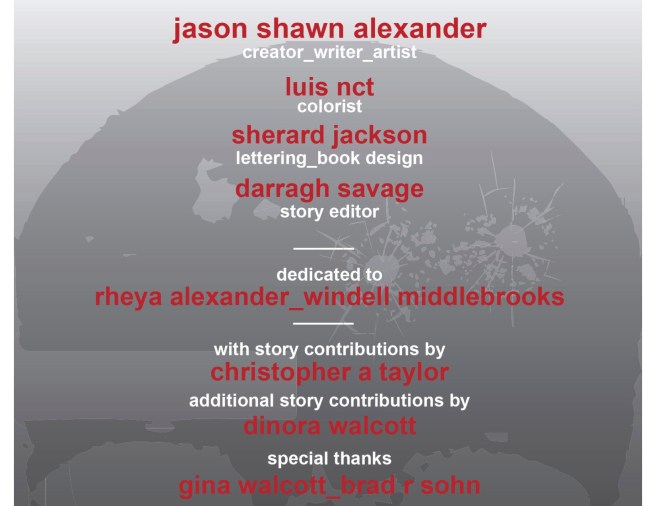
The Empty Zone trade paperback from Image Comics and Jason Shawn Alexander came out last week. What a lot of people likely won’t notice is that my name is in the credits as “With Story Contributions By.” See attached image.

Interestingly, they also gave a story contribution credit to the creator’s wife. I sure hope Mrs. Alexander didn’t have to go to the same lengths that I did to get mine. Of course, the real intent of her credit is to dilute the significance of mine.

To be perfectly clear, I lay no claim to the version of Empty Zone that was published. It just so happens that many scenes, dialogue, characters and plot elements from the four scripts that I wrote over ten months were used after I had left the project over ethical differences. It was not a work for hire gig, so the creator did not have the rights to my work.

Let this be a lesson to experienced and aspiring alike: Have a written agreement in advance, even just a rudimentary one. Even with those you consider your close friends. Especially your friends.
Lesson learned. I’m thankful to now be working with people who put craft before profit. And the result will be that much better because of that.

I will always go out of my way to treat people better than I’ve been treated. I believe in collaborations where all involved are equals. Because that’s how lasting relationships can thrive; where collaborators lift each other up and recognize that these stories are the result of all our efforts, not just an individual.

EZ CREDITS

Clowning Around

With several things in the works, I’ve decided to start a blog so that I can keep people informed about what my collaborators and I are up to, especially in regards to  Visions from Punktown.

I thought it’d also be fun to post some of my work, published and unpublished. As a writer, I always believe my best stuff is ahead of me, so I keep plugging away.

I always enjoy talking about the creative process, so don’t be shy about engaging me. I’ve also got some ideas for some fun interactive creative exercises to make things interesting.

First up, my official foray into comics…

creepy6
The cover for Creepy #6, featuring me as your typical homicdial, happy time fun-making clown.

I sold my first comic book script to Dark Horse Comics for Creepy #6, published in June 2011. It was actually on a whim. I had just made the semi-finals in a short screenplay competition and was planning to fully throw myself into screenwriting when someone asked me if I wanted to write a story for him to illustrate for Creepy.

I’d always wanted to write comic books. I had literally been reading them all my life, and had worked in comic book retail for a decade. I even self-published a crappy comic when I was 21. Comics are part of my DNA, having read them all my life. My uncle had even read them to me while I was still in a crib. So the answer was a hearty “Hell, yes!”

I sent them a few pitches, and they chose the as of then untitled “Commedia dell’Morte.” It was originally a longer idea I had come up with that the artist wanted to keep for ourselves, but we decided to use it as a means of getting my foot in the door and start promoting ourselves as a creative unit.

The idea came about from brainstorming what the artist might like to draw. I started with monsters, then monster hunters. I wanted a juxtaposition, so I landed on clowns. And with the element of children’s parties, the story and subtext just started coming together. I love playing with story devices, and the unreliable narrator in this case worked out wonderfully. Dan Braun, owner of Creepy, suggested a different ending that was a vast improvement over my own, and we had our story.

I write panel by panel scripts, but it’s never intended that the artists should rigidly follow my scripts without question. I value input and ideas from the artist. I’ve been working in film and television for ten years now, and cinema is a heavy influence on my mind’s eye, so I see things as if through a camera lens, like a cinematographer. The artist on Creepy #6 saw the same things I did and produced some amazing pages. It was also a blast because my wife and I posed as the parent characters, and I got to model for the front cover (which, incidentally, made it into Spectrum 19: The Best in Contemporary Fantastic Art).

I thought about scanning my hand-written notes to give some insight into my creative process, but the truth is they’re probably illegible to anyone but me. So here is the script for the story. Following the script will be the pitch that sold the story, with the original ending. As I mentioned, Dan Braun suggested a much better ending that really increased the story’s impact.  Also, enjoy some page samples below. You can purchase this issue for $1.99 through Comixology: https://www.comixology.com/Creepy-Comics-6/digital-comic/277497?ref=c2VyaWVzL3ZpZXcvZGVza3RvcC9ncmlkTGlzdC9Jc3N1ZXM

Personally, I find great value in reading the scripts of other writers, studying their pacing and structure. So maybe one of you out there will get that same value from seeing my work. If nothing else, this keeps the brain muscles active.

THE SCRIPT:

(Click the links to view)

COMMEDIA DELL’MORTE 05-06-11

THE PITCH:

COMMEDIA PITCH